Electricity demand from data centers is rising rapidly. The International Energy Agency projects that global data-center electricity consumption will reach approximately 945 TWh by 2030, with AI as the most important driver of this growth.
Artificial intelligence data centers (AIDCs) power systems must support more than increasing energy consumption. High-density GPU computing, changing workloads, and cooling equipment create demanding requirements for response speed, power quality, supply continuity, and backup duration.
This article explains the power challenges facing AIDC, how battery energy storage supports different operating needs, why millisecond response and multi-hour backup require coordinated storage resources, and what operators should evaluate when planning an AIDC energy storage system.
AIDC power challenges fall into two main categories: fast power events that develop within milliseconds or seconds, and sustained energy requirements that can continue for minutes or hours. This distinction determines whether a storage system needs high power, greater usable energy, or both.
Rapid load fluctuations: GPU clusters can increase or reduce electricity consumption quickly as training and inference workloads change. The synchronized operation of large AI chip clusters can also produce repetitive load oscillations that affect nearby electrical equipment and the grid.
Power-quality disturbances: Voltage sags, frequency deviations, and brief grid events may affect computing stability without causing a prolonged outage. UPS systems help maintain load continuity and power quality, but their available support time depends on the connected energy storage and actual load.
Extended supply interruptions: Grid outages, capacity constraints, or delayed utility connections may require continued support for critical IT loads, cooling equipment, controls, and auxiliary systems.
Renewable energy mismatch: Solar and wind output does not always coincide with continuous AIDC demand. Energy may need to be stored for periods of lower renewable generation or higher computing demand.
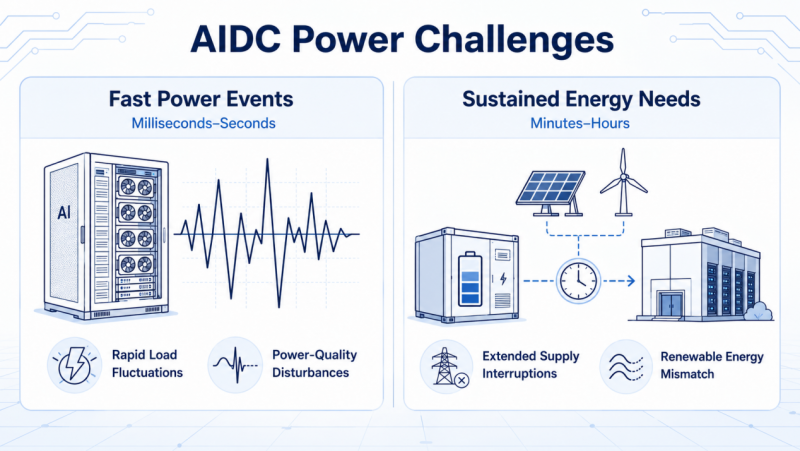
Fast power events require rapid response and sufficient output power. Sustained energy challenges require enough usable energy to maintain selected loads for the required duration.
Battery energy storage helps AIDC stabilize rapidly changing loads, maintain power quality, extend backup duration, manage peak demand, and use renewable energy more effectively.
Its main functions include:
Load smoothing: The battery absorbs or releases power during sudden changes in GPU demand, reducing the impact on site electrical equipment and the upstream grid.
Power-quality support: When integrated with the site PCS, UPS, and/or high-voltage DC architecture, storage can support brief voltage, frequency, and power disturbances within the defined protection and control strategy.
Extended backup: Battery storage can support selected IT, cooling, control, and auxiliary loads during longer grid interruptions or supply constraints.
Peak management: Stored energy can be discharged during periods of high computing demand or high electricity prices, reducing peak demand pressure.
Renewable energy shifting: Excess wind or solar generation can be stored and delivered when renewable output falls or AIDC demand increases.
These applications span very different time scales. Some require high power within milliseconds, while others require sustained energy delivery for several hours. Storage selection must therefore consider both power capability and energy duration.
Storage solutions that handle both long-duration backup and millisecond power response for data centers typically use a coordinated hybrid or multi-duration architecture. This is because response speed and backup duration represent two different system requirements.
Fast response is primarily a power requirement. The battery, PCS, and control system must absorb or deliver power quickly enough to smooth sudden GPU load changes. Simply increasing battery capacity does not guarantee faster response or higher short-term power output.
Long-duration backup is primarily an energy requirement. The system must store enough usable energy to support critical loads during an extended outage, renewable energy shortfall, or grid-capacity constraint. A high-power battery with limited energy capacity cannot sustain these loads for several hours.
AIDC storage should therefore be planned across three time scales:
Instantaneous response: Manage millisecond-level load changes and brief electrical disturbances.
Short-duration regulation: Address repeated load fluctuations, temporary peaks, and short grid constraints.
Multi-hour support: Provide extended backup and shift renewable energy across longer periods.
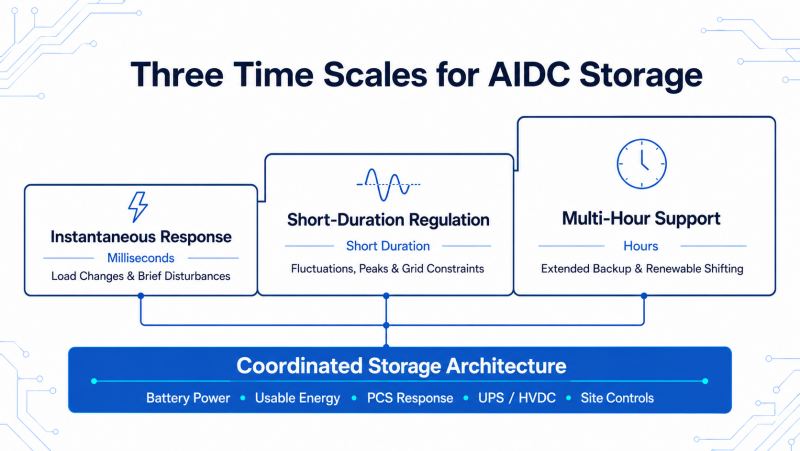
The final architecture should coordinate battery power, usable energy, PCS response, UPS or high-voltage DC interfaces, and site-level controls. Each storage layer can then perform the duty for which it is best suited.
Storage selection should begin with operating scenarios rather than a preferred battery duration.
Measure GPU load ramp rates, fluctuation frequency, peak-to-average demand, and the percentage of critical load. A site’s peak MW value alone does not show how quickly the storage system must respond or how often it will cycle.
Evaluate the battery, PCS, controls, and electrical interface as one system. Confirm that the complete configuration can respond to the required load change and coordinate with the existing UPS, AC distribution, or high-voltage DC architecture.
Calculate energy requirements separately for brief grid disturbances, longer outages, renewable generation shortfalls, and planned load management. Critical IT loads, cooling systems, pumps, controls, and other essential equipment may require different backup priorities.
Review integration with utility power, renewable generation, diesel generators, energy management platforms, and existing protection systems. The design should also allow for future increases in rack density and computing capacity.
Two-hour, four-hour, and eight-hour configurations are not a fixed ranking of better or worse options. Each duration should match the site’s risks, grid conditions, renewable energy share, and continuity objectives.
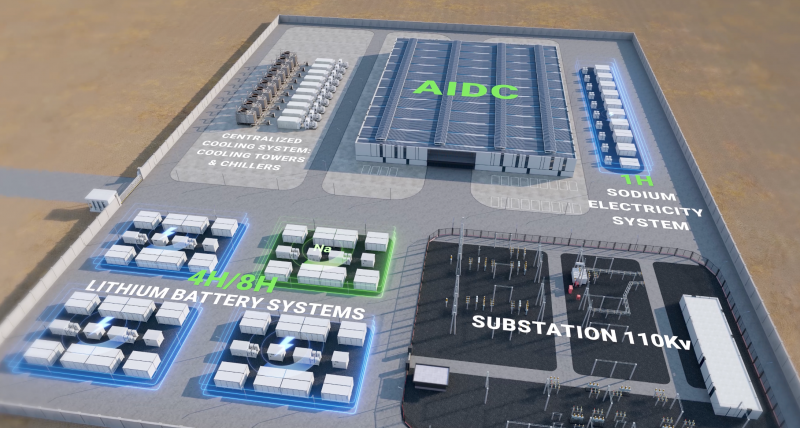
At HiTHIUM, we developed the ∞Power Solutions for AI Data Center as the world’s first lithium-sodium coordinated, full-duration AIDC energy storage solution.
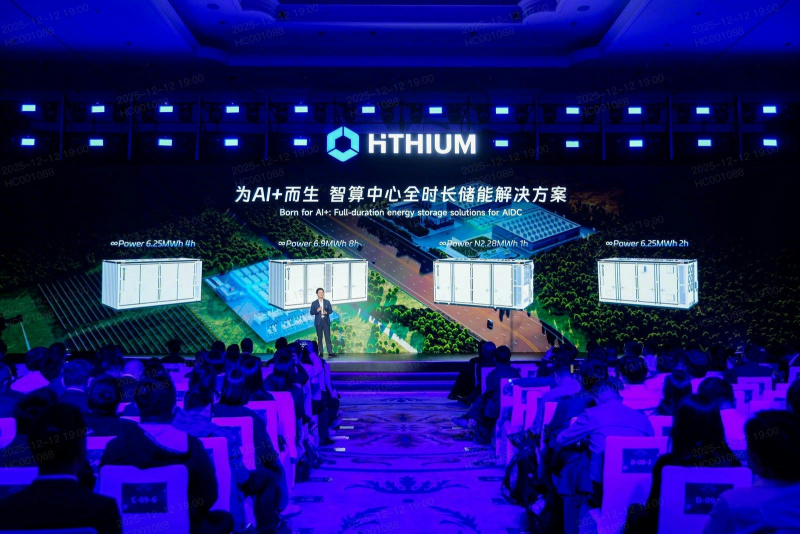
The architecture assigns fast power response and sustained energy delivery to different storage layers instead of requiring one battery configuration to perform every task.
High-rate sodium-ion storage focuses on rapid power delivery and millisecond-level load smoothing.
Long-duration lithium-ion storage provides the energy capacity required for extended backup, campus load balancing, and renewable energy shifting.
Configuration | Primary role in an AIDC |
∞Power N2.28MWh 1h | High-rate sodium-ion storage for rapid power support and millisecond-level load smoothing |
∞Power 6.25MWh 2h | Short- to medium-duration regulation, subject to the site operating scenario |
∞Power 6.25MWh 4h | Extended backup and campus-level load balancing |
∞Power 6.9MWh 8h | Long-duration energy shifting and extended energy continuity |
HiTHIUM’s ∞Power Solutions for AI Data Center (AIDC) can connect with existing AIDC power architectures through a fast-response PCS and can interface with next-generation high-voltage DC systems through DC/DC equipment. Under the corresponding system configuration, response time can be reduced to below 10 milliseconds.
Actual system sizing should still be based on the site load profile, critical-load strategy, backup objectives, grid connection, and renewable generation plan. This allows the lithium and sodium-ion layers to be configured around measurable project requirements.
Many AIDCs require energy storage that can respond to rapid load changes while maintaining power for longer disruptions. The right solution must balance millisecond-level power support, power quality, and multi-hour energy continuity.
HiTHIUM’s ∞Power Solutions for AI Data Center combines high-rate sodium-ion storage with long-duration lithium-ion storage to support these requirements within one coordinated architecture.
For AIDC operators and data center energy planners, contact HiTHIUM to explore how ∞Power Solutions for AI Data Center can combine fast power response with long-duration energy resilience for your project.
International Energy Agency. Energy and AI: Energy Demand from AI.
https://www.iea.org/reports/energy-and-ai/energy-demand-from-ai


 Previous: