BESS fire safety depends on how a complete system responds when a cell enters thermal runaway. A cell certificate may confirm basic safety performance, but it alone does not show whether heat, combustible gases, or flames will spread through a multi-MWh installation.
Meaningful test evidence should demonstrate how a representative BESS reduces failure risk, detects abnormal conditions, releases pressure, and contains thermal runaway at the cell, pack, system, and installation levels.
This article explains which tests provide meaningful safety evidence and why large-scale open-door testing matters.
Thermal runaway becomes a system-level risk when the heat and gases released by one cell affect neighboring cells, modules, or storage units. Effective protection must therefore limit both the probability of cell failure and the consequences if failure occurs.
Thermal runaway occurs when self-heating inside a battery cell exceeds its ability to dissipate heat. Possible initiating conditions include an internal short circuit, overcharge, external heating, mechanical damage, or a manufacturing defect.
A failing lithium-ion cell may release high-temperature gases, hot particles, smoke, and flames. The event can develop into a larger BESS fire when:
Heat raises adjacent cells above their safe temperature limits.
Combustible gases accumulate inside a pack or enclosure.
Vented combustible gases ignite and produce a deflagration or flame jet.
Sustained heat reaches adjacent battery units.
Fire suppression and thermal-runaway propagation prevention perform different functions. Extinguishing visible flames does not necessarily stop the internal reactions generating heat. The BESS must also isolate or dissipate enough heat to protect nearby cells and modules.
BESS fire safety should be built through four complementary protection levels:
Cell level: A stable electrochemical system, consistent manufacturing, reliable separators, electrical protection, and controlled cell venting reduce the probability and severity of failure.
Pack level: Inter-cell thermal barriers, structural restraint, directed airflow, and module pressure relief limit heat transfer and pressure accumulation.
System level: The battery management system, liquid cooling, temperature and gas detection, electrical isolation, compartmentation, and active fire protection identify and manage abnormal conditions.
Site level: Unit spacing, fire access, water supply, drainage, isolation zones, and emergency procedures limit consequences beyond the initiating system.
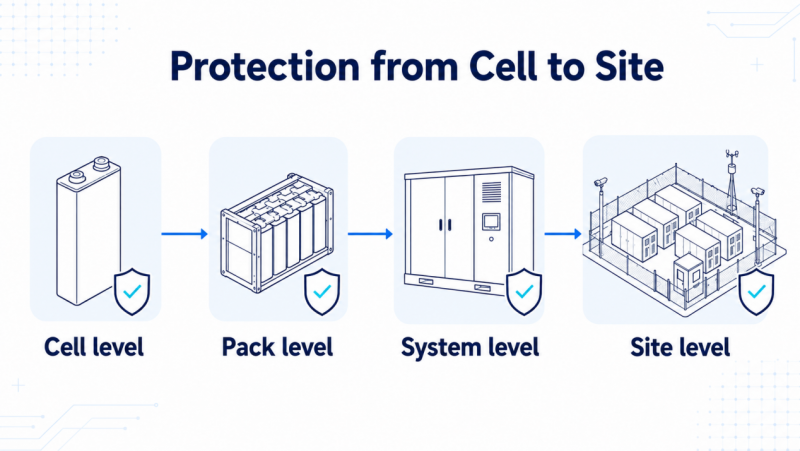
These layers work together. Active fire protection cannot replace the intrinsic and passive safety measures built into the cell, pack, and enclosure.
Common battery and BESS standards evaluate different safety risks. Together, they establish the basic safety evidence required before system-level fire performance is considered.
Standard or test | Main evaluation |
IEC 62619 | Safety and abuse resistance of industrial lithium cells and batteries |
UL 1973 | Safety of batteries used in stationary applications |
UN 38.3 | Battery safety under transportation conditions |
UL 9540 | Safety of the complete energy storage system and its integrated equipment |
UL 9540A | Thermal-runaway behavior, gas release, heat generation, propagation, and fire hazards |
NFPA 855 | Installation requirements for spacing, ventilation, fire protection, and emergency response |
The fire-safety tests required for a grid-scale BESS vary by market, but the evidence should cover cell safety, stationary battery safety, complete-system integration, thermal-runaway propagation, and installation requirements
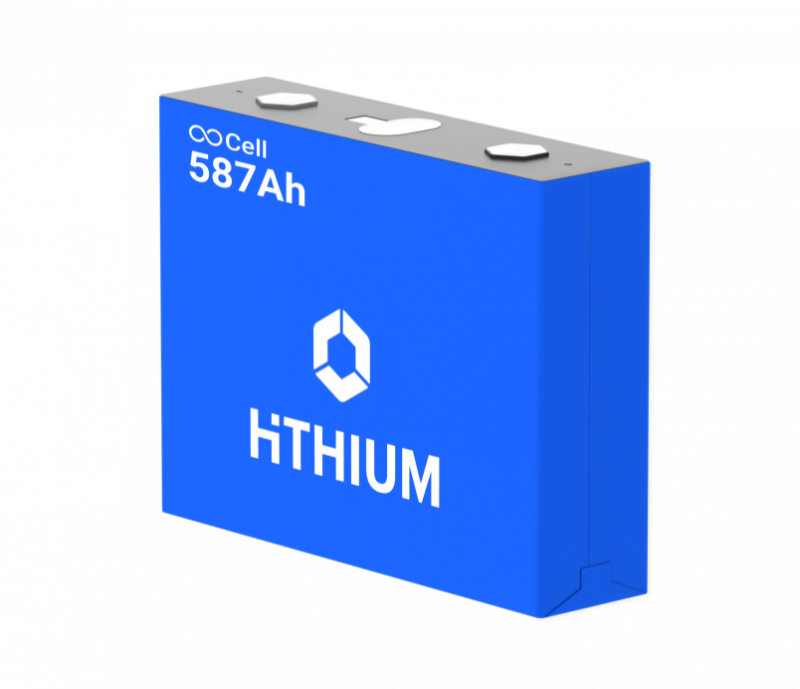
HiTHIUM has developed the ∞Cell 587Ah and ∞Cell 1175Ah for high-capacity energy storage applications. Both use LiFePO₄ chemistry and have completed safety evaluations covering industrial operation, stationary use, thermal runaway, and transportation.
The ∞Cell 1175Ah is supported by certifications and test documentation covering IEC 62619, UL 1973, UL 9540A, and UN 38.3. Together, this evidence addresses safety requirements for industrial and stationary battery use, characterizes thermal-runaway response, and documents performance under transport-related test conditions.
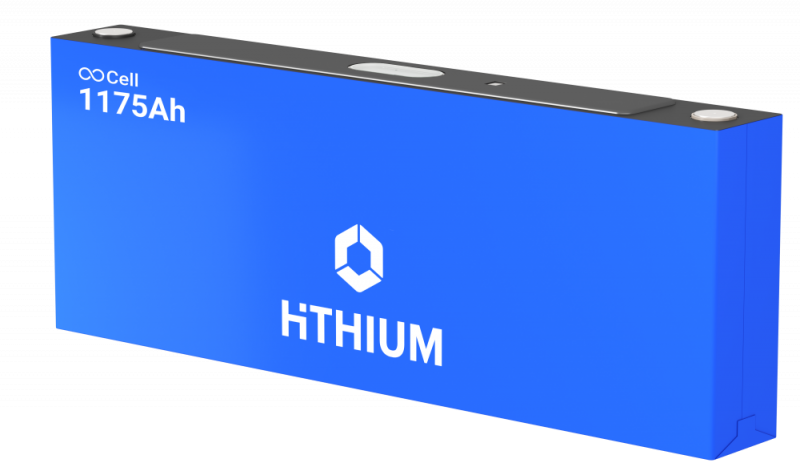
For the ∞Cell 587Ah, the safety evidence includes IEC 62619, UL 1973, UL 9540A, GB/T 36276, and UN 38.3. This combination supports its use in stationary energy storage by covering battery safety, thermal-runaway evaluation, and the environmental and mechanical conditions associated with transportation.
These results establish the cell-level safety foundation for HiTHIUM’s high-capacity BESS products. Representative large-scale open-door testing extends this evidence to the complete system by directly evaluating sustained combustion, passive containment, adjacent-unit protection, and structural integrity.
An open-door fire test keeps the doors of the initiating BESS enclosure fully open during thermal runaway and sustained combustion. This configuration maintains oxygen supply and exposes the system and adjacent units more directly to flames, hot gases, and radiant heat.
At a representative full-system scale, the test evaluates three main areas:
Pressure and gas release: Whether the event produces an explosion, debris ejection, or uncontrolled high-temperature gas release.
Fire propagation: Whether flames and heat affect adjacent BESS units and how their temperatures respond.
Structural integrity: Whether the initiating enclosure remains stable during prolonged combustion.
The results provide direct evidence of system-level fire containment under sustained flame exposure.
HiTHIUM develops energy storage safety from the cell to the complete BESS unit. HiTHIUM became the first manufacturer to complete a publicly disclosed open-door large-scale fire test and has conducted this type of testing on both 5MWh and 6.25MWh systems.
HiTHIUM conducted an open-door large-scale fire test on the ∞Power 6.25MWh 4h, a containerized liquid-cooled BESS unit built with the prismatic LFP ∞Cell 1175Ah. Representatives from UL Solutions, U.S. AHJs, and fire-protection engineers supervised the test.
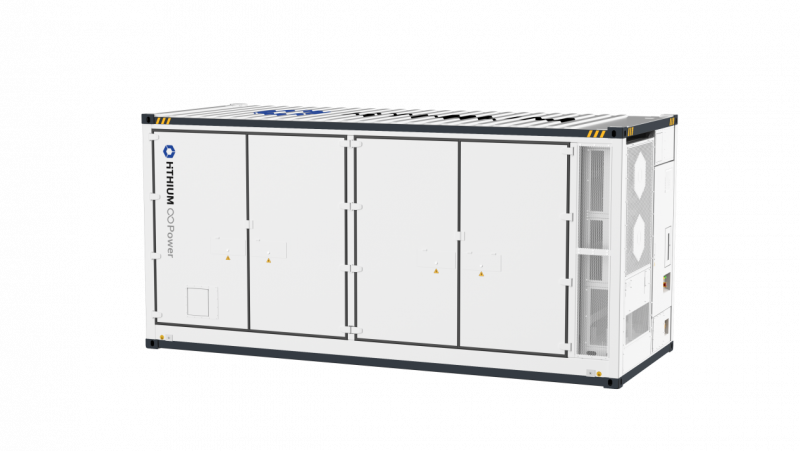
The test conditions included:
100% state of charge
Container doors open throughout combustion
All active fire-suppression systems disabled
Adjacent units positioned side by side and back to back
Only 15 cm between containers
The system combines a three-dimensional airflow channel, directed venting, and dual module pressure-relief valves to control high-temperature gas release. Fire-resistant module covers and multilayer container insulation limit thermal propagation, while a reinforced steel enclosure, high-strength frame, structural stiffeners, and dual-layer partitions provide structural protection.
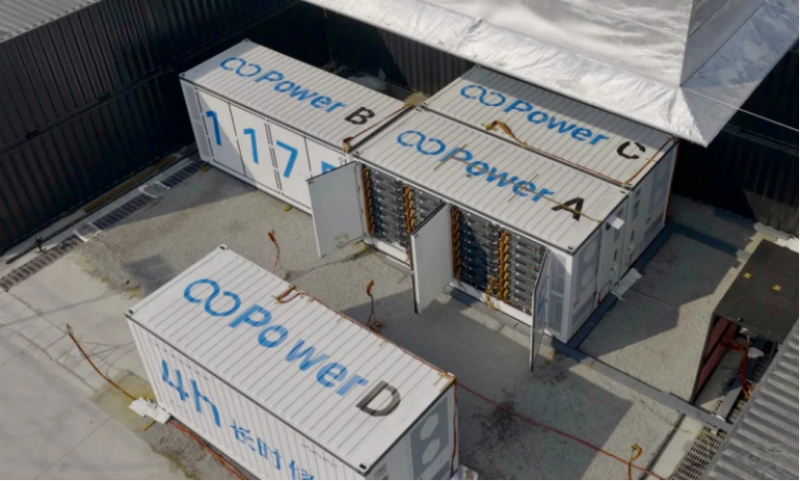
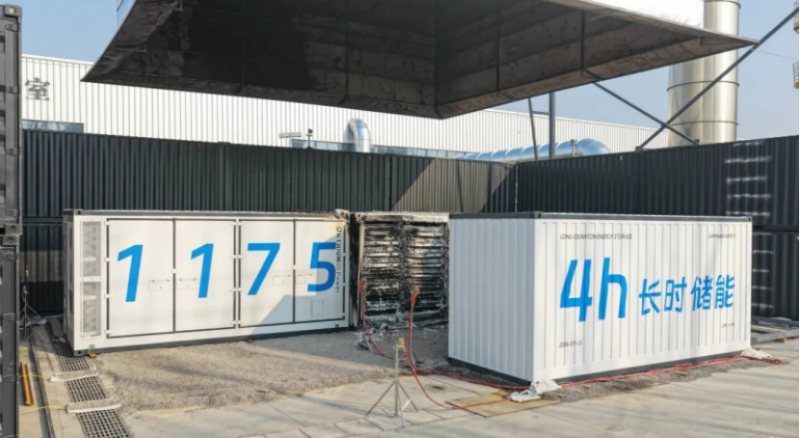
No explosion or debris ejection occurred. Fire remained within the initiating BESS unit, while cell temperatures in adjacent containers stayed below the specified safety thresholds. The affected container also remained structurally intact, with no significant deformation or collapse after sustained combustion.
Beyond the ∞Power 6.25MWh 4h, HiTHIUM continues to extend safety technologies across our long-duration energy storage portfolio. The newer 8-hour-native platform introduces mass-produced high-strength steel-belt confinement, rapid dual-valve pressure relief, and insulation materials designed to withstand 800°C and 300 kPa.
Together with representative large-scale fire testing, these developments reflect HiTHIUM’s safety approach from cell materials and pressure management to complete-system fire containment.
BESS fire safety depends on layered protection and evidence at the correct scale. Cell and battery standards establish the safety baseline, while complete-system evaluation and representative fire testing show how thermal runaway, combustible gases, heat, and flames are managed beyond the initiating cell. Open-door large-scale testing provides particularly direct evidence of passive containment, adjacent-unit protection, and structural integrity.
HiTHIUM develops safety technologies from the ∞Cell 587Ah and ∞Cell 1175Ah to complete utility-scale BESS units. The ∞Power 6.25MWh 4h combines the ∞Cell 1175Ah with liquid cooling, directed venting, dual module pressure relief, thermal barriers, and a reinforced enclosure. Its open-door test extends cell-level safety evidence to full-system fire performance under demanding conditions.
Contact HiTHIUM to request product specifications, fire-test documentation, and technical support for your BESS project.
Sandia National Laboratories. Grid-Scale Energy Storage Hazard Analysis and Design Objectives.
https://www.sandia.gov/app/uploads/sites/163/2021/08/Rosewater-APS.pdf
International Electrotechnical Commission. IEC 62619:2022—Safety Requirements for Industrial Lithium Cells and Batteries.
https://webstore.iec.ch/en/publication/64073
UL Solutions. Energy Storage System Testing and Certification.
https://www.ul.com/services/energy-storage-system-testing-and-certification
United Nations Economic Commission for Europe. Manual of Tests and Criteria, Revision 8.
https://unece.org/sites/default/files/2024-09/ST_SG_AC.10_11_Rev.8e_WEB.pdf
UL Solutions. UL 9540A Test Method for Battery Energy Storage Systems.
https://www.ul.com/services/ul-9540a-test-method
National Fire Protection Association. NFPA 855 Fire and Explosion Testing Requirements.
https://docinfofiles.nfpa.org/files/AboutTheCodes/855/TIA_855_23_1.pdf




 Previous: