Utility-scale BESS design is moving beyond 314Ah cells toward 500Ah+ and kAh-class cells. These ultra-large cells now have the manufacturing, safety-testing, shipment, and system-integration evidence needed for qualified grid-scale deployment, but greater capacity alone does not prove maturity or guarantee lower cost.
This article evaluates whether ultra-large cells are ready for grid-scale deployment by examining their integration and cost impact, technical trade-offs, suitability for four-hour projects, and evidence of manufacturing and commercial maturity.
Ultra-large cells generally refer to cells above 500Ah, including kAh-class designs. For cells with comparable nominal voltage, higher Ah capacity increases the energy stored in each cell. For a BESS with a fixed energy rating, this can reduce the total number of cells, although series count still depends on the required system voltage.
The main advantages include:
· Fewer cells and connections: A lower total cell count can reduce busbars, terminals, fasteners, and BMS sampling points.
· Higher system integration: More energy can be integrated into each pack and container.
· Simpler assembly: Fewer components can reduce production, installation, inspection, and maintenance steps.
· Potential cost and footprint reductions: Higher integration may reduce balance-of-system hardware, installation work, and land requirements.
The main challenges include:
· More energy per cell: Each cell contains more energy, increasing the importance of effective fault containment.
· More demanding thermal control: Larger cell formats can increase the design challenge of internal heat removal and temperature uniformity.
· Stricter manufacturing consistency: Large electrode areas and thicker coatings can require tighter process control.
· Greater structural requirements: Cell swelling and mechanical restraint must be managed throughout the operating life.
· Higher failure consequences: Fault isolation and thermal propagation protection become more critical when one cell fails.
Ultra-large cells can improve integration efficiency, but those gains translate into lower costs only when cooling, manufacturing consistency, structural protection, and system safety are addressed together.
Large-capacity cells can improve BESS economics by reducing component count and integration work, but the resulting savings must be verified at the complete-system level.
The basic relationship is:
Higher cell capacity → fewer total cells and connection components → simpler pack integration → fewer assembly and installation steps → potential capital and maintenance savings.
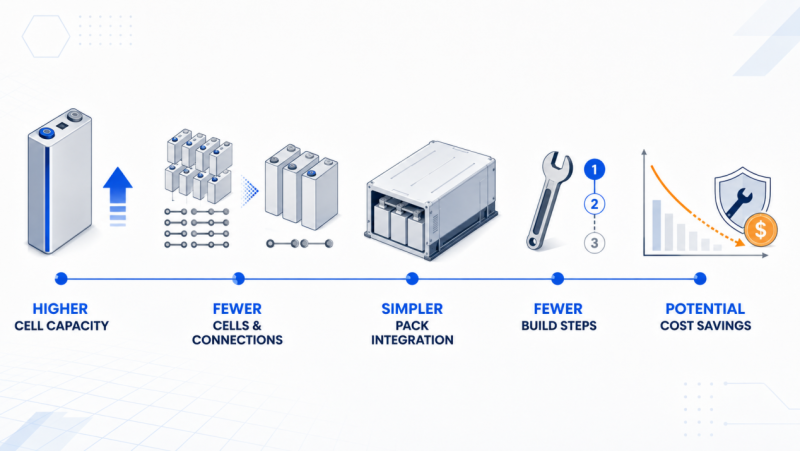
This chain is not automatic. Larger cells may require more advanced cooling plates, stronger restraint structures, pressure-relief designs, additional insulation, or more capable fault-protection systems. Manufacturing yield, cell consistency, spare-pack and replacement strategy, auxiliary power consumption, degradation, warranties, and future augmentation can also offset initial savings.
Project teams should consequently compare complete systems using:
· Guaranteed usable energy at commissioning and end of warranty
· Round-trip efficiency measured at the same system boundary
· Cooling and other auxiliary power requirements
· Installation and commissioning costs
· Degradation, replacement, and augmentation assumptions
· Levelized cost of storage, or LCOS
The U.S. Department of Energy’s grid storage assessment includes charging energy, operations and maintenance, augmentation, and equipment replacement in LCOS analysis. This broader method gives buyers a more reliable comparison than cell price per Ah.
Cell capacity alone cannot determine whether a 587Ah or 314Ah cell is better for a four-hour utility project. A 587Ah design can reduce total cell count and improve integration, but the two solutions may use different series-parallel architectures, discharge rates, cooling systems, usable SOC windows, and maintenance strategies.
A valid comparison must hold the following conditions constant:
· Required usable MWh
· Four-hour operating duty
· Site temperature and altitude
· Efficiency measurement boundary
· Degradation and augmentation assumptions
· Warranty period and availability guarantee
HiTHIUM’s product architecture illustrates why duration-specific system design matters. The company’s ∞Power 6.25MWh platform pairs the ∞Cell 587Ah with its two-hour configuration and the ∞Cell 1175Ah with its four-hour configuration.
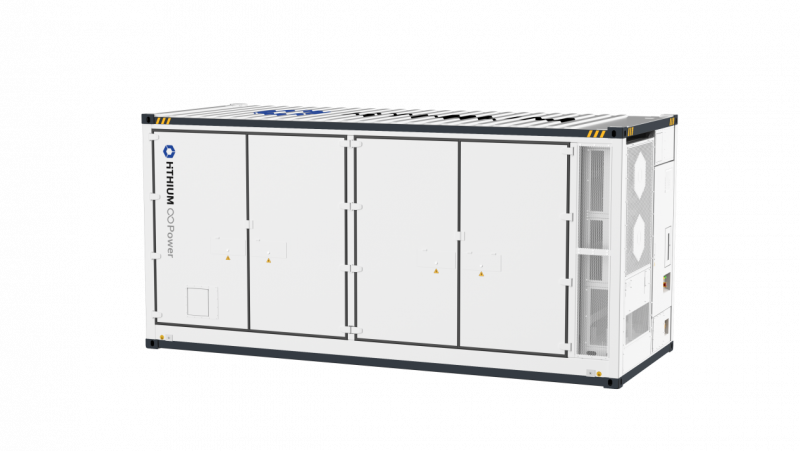
The ∞Power 6.25MWh 4h system
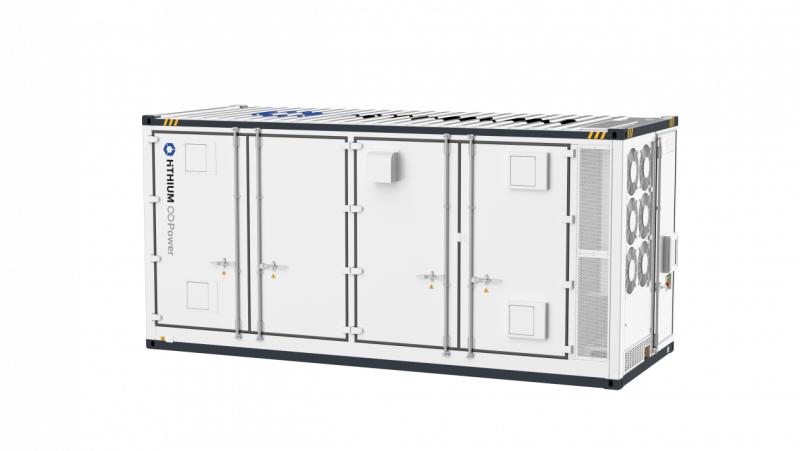
The ∞Power 6.25MWh 2h system
Therefore, the ∞Cell 1175Ah is the more direct match for a four-hour HiTHIUM utility-scale project. This does not mean that 587Ah is universally better than 314Ah—or that 1175Ah is universally better than both. It means the cell must be evaluated within a complete BESS architecture designed for the target discharge duration.
Matching cell capacity to project duration is only the first step. Grid-scale readiness also requires evidence that the cell can be manufactured consistently, delivered commercially, operated over a defined lifecycle, and safely integrated into a complete BESS.
Four types of evidence provide a stronger maturity test than cell capacity alone:
1. Manufacturing maturity: Stable mass production supported by process and consistency controls.
2. Commercial delivery: GWh-scale cell shipments and adoption in commercially delivered utility systems.
3. Lifecycle performance: Verified cycle life under defined operating conditions.
4. Safety and system validation: Relevant cell testing, system-level fire testing, and integration into a complete commercial BESS.
HiTHIUM’s cell specifications, production records for the ∞Cell 587Ah and∞Cell 1175Ah, and published shipment data provide evidence across the four maturity criteria.
Readiness evidence | ∞Cell 587Ah | ∞Cell 1175Ah |
Manufacturing maturity | Mass production and first-batch delivery began in August 2025. | Mass production began in June 2025. |
Commercial delivery | GWh-scale shipments achieved; integrated into the ∞Power 6.25MWh 2h. | GWh-scale shipments achieved; the 4h system began global deliveries in October 2025. |
Lifecycle performance | ≥11,000 nominal cycles | ≥11,000 nominal cycles |
Safety and system validation | IEC 62619 and UL 1973 certified; UN 38.3 testing completed; GB/T 36276; integrated into the 2h system, which has completed UL 9540A testing | IEC 62619 and UL 1973 certified; UN 38.3 testing completed; GB/T 36276; integrated into the 4h system, which has completed UL 9540A testing. |
Taken together, these records show a continuous path from cell production to duration-specific system deployment. The ∞Cell 587Ah supports HiTHIUM’s two-hour architecture, while the ∞Cell 1175Ah supports the four-hour configuration and has progressed to global system delivery. This evidence allows each cell to be evaluated as part of a complete BESS rather than as an isolated Ah rating.
Ultra-large cells are ready for qualified utility-scale deployment, but their value must be measured at the complete-system level. Within HiTHIUM’s current architecture, the ∞Cell 587Ah matches two-hour high-capacity projects, while the ∞Cell 1175Ah supports the four-hour ∞Power 6.25MWh configuration.
Discuss your project duration and BESS integration requirements with HiTHIUM to identify the appropriate high-capacity cell architecture.
1. Are 500Ah+ cells mature enough for utility-scale BESS?
Yes, qualified 500Ah+ products can support utility-scale deployment. Readiness depends on manufacturing scale, lifecycle data, safety testing, system integration, and commercial delivery—not Ah capacity alone.
2. Do larger battery cells always reduce BESS costs?
No. Fewer components can reduce integration costs, but cooling, structural protection, auxiliary consumption, manufacturing yield, replacement strategy, and augmentation can offset the savings.
3. Is a 587Ah cell better than a 314Ah cell for a four-hour project?
Not necessarily. Buyers must compare complete four-hour systems under the same usable-energy, operating, degradation, efficiency, and warranty assumptions.
4. Why does HiTHIUM use the 1175Ah cell for its four-hour BESS?
HiTHIUM developed duration-specific configurations on its high-capacity platform. The ∞Cell 1175Ah is integrated into the ∞Power 6.25MWh 4h system, while the ∞Cell 587Ah supports the two-hour configuration.
5. Are Ultra-Large Cells more difficult to cool?
They are not necessarily hotter in operation, but larger cell formats can make temperature uniformity and internal heat removal more demanding. Cooling must be evaluated at cell, pack, and container levels.
[1] U.S. Department of Energy. 2022 Grid Energy Storage Technology Cost and Performance Assessment.
https://www.energy.gov/cmei/2022-grid-energy-storage-technology-cost-and-performance-assessment
[2] International Electrotechnical Commission. IEC 62619:2022—Safety Requirements for Secondary Lithium Cells and Batteries Used in Industrial Applications.
https://webstore.iec.ch/en/publication/64073
[3] UL Solutions. UL 9540A Test Method for Battery Energy Storage Systems (BESS).
https://www.ul.com/services/ul-9540a-test-method




 Previous: