The global energy storage market is entering a new phase of GW-scale deployment, driven by renewable energy expansion, increasing grid flexibility requirements, and growing demand for long-duration energy storage solutions. The International Energy Agency (IEA) highlights that battery storage is becoming increasingly important for supporting renewable integration, improving power system flexibility, and enhancing grid reliability.
As utility-scale projects continue to expand, energy storage systems are evolving from earlier 3MWh-class products toward higher-capacity and more integrated 6.9MWh+ solutions for large renewable energy bases, grid-side applications, and long-duration energy storage projects.
This article examines the key factors that define a high-quality 6.9MWh+ energy storage system, providing a structured framework for project developers and buyers to evaluate system performance, reliability, and long-term project value beyond capacity and initial procurement costs.
Not every energy storage application requires a 6.9MWh+ system. The appropriate capacity depends on operating objectives, discharge duration, and site-specific power demands. High-capacity systems are typically selected for applications where extended energy delivery and operational resilience are critical.
Grid-side peak shaving requires large energy capacity combined with long-duration discharge capability to support periods of high electricity demand or reduced renewable generation. The value of a 6.9MWh+ system in this scenario comes from its ability to provide sustained power output over extended periods, helping improve grid flexibility and reduce reliance on additional peak-generation resources.
Four-hour-plus long-duration energy storage projects focus on shifting energy across different time periods, such as storing excess renewable generation and releasing power when demand increases. The value of a 6.9MWh+ system lies in its greater energy-shifting capability, enabling more stored energy to be delivered throughout the project lifecycle and improving long-term economic returns.
Large-scale renewable-paired storage projects require high-capacity systems to match the output fluctuations of utility-scale solar and wind generation. As project capacity grows into hundreds of megawatt-hours, larger-format systems help reduce the number of deployed units, improve land utilization, and simplify overall project deployment.

Products with the same nominal 6.9MWh+ capacity can deliver different project outcomes after deployment. While capacity and initial procurement cost are important considerations, they do not fully represent system performance, operational reliability, or long-term economic value.
For utility-scale energy storage projects, buyers should evaluate 6.9MWh+ systems across five key dimensions:
Evaluation Dimension | What Buyers Should Evaluate | Impact on Project Value |
Energy Density per Unit Footprint | Usable energy capacity per container, system footprint, and space utilization efficiency. | Determines land utilization and deployment efficiency for large-scale projects. |
System Integration Level | Battery cell capacity, system architecture, component integration, and deployment configuration. | Affects installation complexity, system consistency, and project delivery efficiency. |
Operation and Maintenance Complexity | System standardization, commissioning requirements, monitoring capabilities, and maintenance workload. | Influences long-term operating costs and asset availability. |
Safety and Reliability | Thermal management performance, protection mechanisms, fault detection capability, and operational stability. | Supports safe operation and reduces potential downtime risks. |
Lifecycle Cost | System efficiency, capacity retention, service life, and total operating expenses. | Determines long-term project economics beyond initial procurement cost. |
These five dimensions provide a practical framework for comparing different 6.9MWh+ energy storage solutions and assessing how suppliers address the technical and operational requirements of large-scale projects. The following section applies this framework to HiTHIUM’s ∞Power 6.9MWh 8h as an example of how these evaluation criteria translate into system design.
HiTHIUM’s newly launched ∞Power 6.9MWh 8h is designed to satisfy all five of these dimensions at once, rather than trading one for another. The breakdown below shows how.
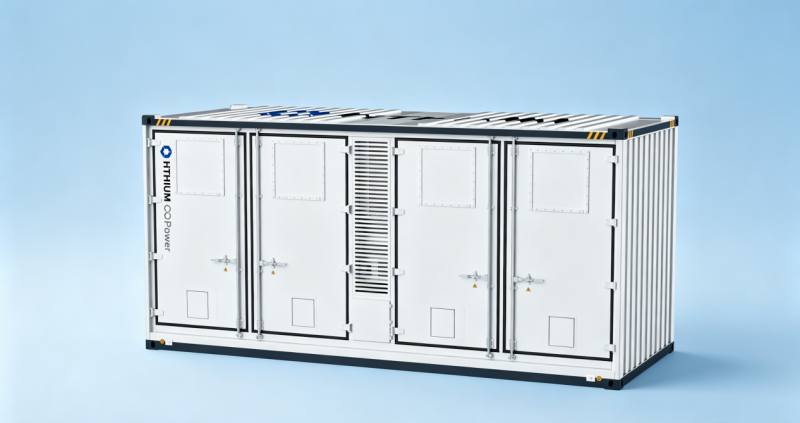
Built around the ∞Cell 1300Ah battery cell dedicated to 8-hour long-duration energy storage (LDES), HiTHIUM ∞Power 6.9MWh 8h delivers more than 6.9MWh capacity within a standard 20-foot container. With a gravimetric energy density of ≥135 Wh/kg and volumetric energy density of ≥160 Wh/L, the system enables higher energy capacity within a compact footprint, helping utility-scale projects improve land utilization and reduce deployment requirements.
Adopting a 4×1P416S configuration, HiTHIUM ∞Power 6.9MWh 8h integrates one medium-voltage module and eight energy storage modules into a standardized system architecture. By using a dedicated 8-hour storage cell and optimized system design, the solution reduces system complexity while improving deployment efficiency for large-scale long-duration energy storage projects.
Supporting both back-to-back and side-by-side installation configurations, HiTHIUM’s ∞Power 6.9MWh 8h provides flexible deployment options for different project layouts. With CAN, RS485, and Ethernet communication protocols, the system supports integration with external energy management systems and simplifies project deployment.
Safety and Reliability
HiTHIUM’s ∞Power 6.9MWh 8h applies a multi-layer safety architecture combining cell-level safety design, container-level protection, and intelligent BMS monitoring. The system also features a multi-stage active fire detection and protection system compliant with NFPA 855, together with liquid cooling and safety design features for long-duration energy storage applications.
Powered by the ∞Cell 1300Ah dedicated 8-hour LDES cell, HiTHIUM ∞Power 6.9MWh 8h is designed for long-duration applications with higher capacity utilization and improved lifecycle economics. With a design life of up to 25 years, the system helps reduce the levelized cost of storage (LCOS) by increasing energy capacity within a single installation unit and improving long-term operational value.
A nominal 6.9MWh+ rating only states how much energy a system is designed to hold — it says nothing about how consistently that capacity can be delivered over years of daily cycling, how much engineering margin protects performance under real operating conditions, or how efficiently that capacity translates into usable project value. Reaching the same capacity number does not mean reaching it the same way, and the difference shows up well after commissioning, once a project depends on that capacity holding up year after year.
This is where HiTHIUM's ∞Power 6.9MWh 8h stands apart. Rather than reaching 6.9MWh+ by simply scaling up cell count within a larger enclosure, the system is engineered from the cell level specifically for 8-hour long-duration operation. Every layer of the design — from cell chemistry to thermal management to system architecture — is built around sustained, full-duration discharge, rather than adapted from a shorter-duration platform to hit a larger capacity number.
This purpose-built foundation is what allows the system to perform consistently across all five evaluation dimensions rather than trading one for another: high energy density does not come at the cost of thermal stability; standardized integration does not compromise safety margins; and higher usable capacity does not shorten service life. For utility-scale projects with a 25-year operating horizon, this distinction — between a system designed for long-duration performance and one simply rated to reach a capacity threshold — is ultimately what separates project economics over the full asset lifecycle.
Selecting a 6.9MWh+ energy storage system requires a comprehensive evaluation of energy density, system integration, operational complexity, safety performance, and lifecycle economics. Capacity and upfront cost alone cannot fully determine long-term project value, as system design and application suitability directly influence performance throughout the asset lifecycle.
HiTHIUM is a global energy storage supplier with dedicated utility, long-duration, and grid-side product lines. We focus exclusively on energy storage battery and system technologies, supported by dedicated R&D capabilities, manufacturing capacity, and global service networks. As of June 2025, HiTHIUM’s global R&D team included more than 1000 engineers, supporting the development of high-capacity energy storage solutions for utility-scale, long-duration, and grid-side applications. The ∞Power 6.9MWh 8h system reflects this approach by providing a purpose-built solution for large-scale long-duration energy storage deployment.
Contact HiTHIUM to explore high-performance energy storage solutions tailored to your utility-scale and long-duration storage requirements.
[1] International Energy Agency (IEA). Batteries and Secure Energy Transitions. IEA, Paris.https://www.iea.org/reports/batteries-and-secure-energy-transitions




 Previous: