From June 23 to 25, the 17th Annual Meeting of the New Champions of the World Economic Forum (Summer Davos Forum) was held in Dalian, Liaoning Province. Under the theme "Innovating at Scale," the forum brought together about 1,800 representatives from political, business, and academic circles, as well as international organizations, from over 90 countries and regions, to discuss new drivers of global economic growth and trends in industrial transformation. Jeff Wu, founder and chairman of HiTHIUM, was invited to attend the forum and participated in the symposium with Premier Li Qiang and business representatives, as well as roundtable discussions, among other events.
Attend a Roundtable Discussion with Business Representatives
On the afternoon of June 24, Premier Li Qiang attended the Business Representatives Symposium of the 2026 Summer Davos Forum in Dalian, with around 150 business leaders from over 30 countries and regions in attendance. Jeff Wu was invited to the event.
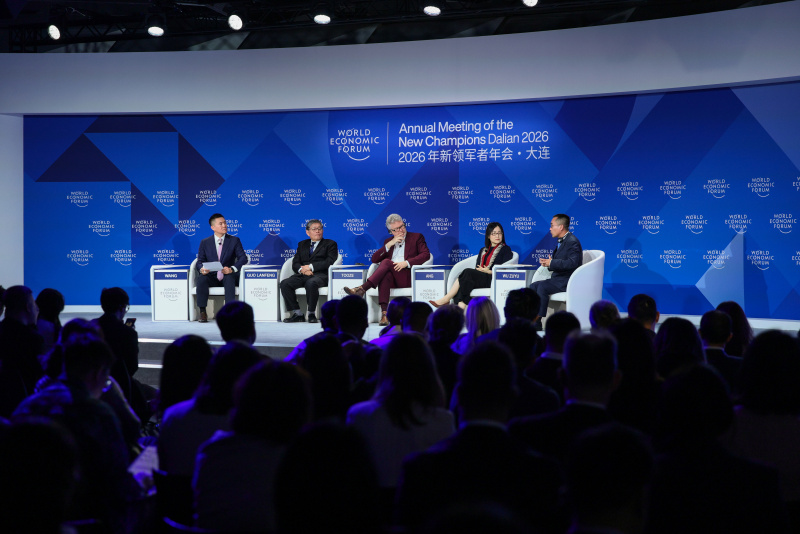
The roundtable discussion
Photo credit: WEF AMNC
Premier emphasized that open cooperation is an irreversible trend of our time and a fundamental requirement for countries to expand development space. China will continue to play an active part in international trade and investment, and promote greater integration between the Chinese market and the global market. As the economy shifts toward innovation‑driven, high‑quality development, the steady upgrading of China's market, manufacturing, and infrastructure will offer broader opportunities for global enterprises. The Chinese government will further open its doors at a higher level and cultivate a more open, fair, and favorable business climate.
On the following morning, at the roundtable discussion “Interpreting the 15th Five-Year Plan,” Jeff Wu shared perspectives from the forefront of industry development. Drawing on practical experience, he exchanged views on China's innovation-driven growth, emerging opportunities in the energy storage industry, the green energy transition, energy security, and the global expansion of Chinese enterprises.
China's Innovation Drive Fosters New Opportunities for Industrial Development
This year coincides with the start of China’s 15th Five‑Year Plan, and new energy storage has been named among the six emerging pillar industries. Jeff Wu noted that China has steadily improved its policy system for new energy and storage in recent years, and market mechanisms like capacity pricing are now taking shape—all sending a positive signal for industrial growth.
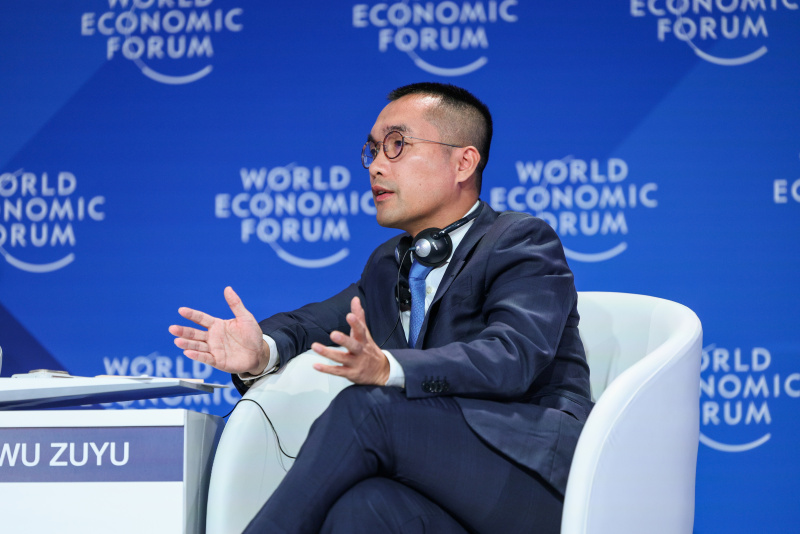
The roundtable discussion
Photo credit: WEF AMNC
"In recent years, the energy storage sector has been primarily policy‑driven, but with market mechanisms maturing, it is now transitioning to a market‑driven phase," he said.
In his view, this transition is not just about industry expansion—it also reflects a profound shift in the industry's growth logic. As technology advances and market mechanisms mature, new energy storage is moving from a policy‑backed emerging sector to a key piece of infrastructure supporting the energy transition.
Jeff Wu projected that by 2030, the global energy storage industry chain could reach a market size of RMB 10 trillion, positioning new energy storage as an independent super‑track—a strategically significant industrial sector with global influence.
Cost Revolution Ushers in a New Era for Green Energy
When asked about the core driver of future growth in the energy storage industry, Jeff Wu offered a straightforward response:
"Many people don't like to talk about it, but the most important thing is cost," he said.
He noted that over the past decade, rapid advancements in renewable technologies such as wind and solar have steadily lowered generation costs, while energy storage has also matured and is now entering a steep cost-reduction phase.
According to HiTHIUM's research and forecasts, the levelized cost of storage (LCOS) for energy storage equipment over its full lifecycle could drop to RMB 0.1 per kWh within the next five years.
"If wind and solar power cost RMB 0.1 per kWh, storage costs RMB 0.1 per kWh, and transmission and distribution add another RMB 0.1, then the comprehensive cost of green energy will enter the 'RMB 0.3 era'," Jeff Wu explained.
He believes this means green energy will be not only cleaner but also fully cost‑competitive.
"When the cost of green energy falls below that of traditional energy, the energy transition will truly enter a market-driven phase," he added.
He further noted that China's current electrification rate is about 28%, compared with a global average of around 20%. As more sectors—industry, transport, buildings, and beyond—continue to electrify, every percentage‑point increase in electrification will generate significant new demand for energy storage.
"The biggest market growth doesn't come from replacing existing energy sources, but from the new demand created by the shift from traditional to green energy systems," he said.
Long‑Duration Energy Storage and Sodium‑Ion Batteries to Become Key Breakthrough Areas
Asked when green energy costs could reach large-scale commercial viability, Jeff Wu pointed to two core technological breakthroughs as essential to realizing the "RMB 0.3 era."
The first is long‑duration energy storage (LDES). "To make green electricity more reliable and stable, short‑duration storage is not enough," he said. As the share of new energy continues to rise, the future power system will require grid‑balancing capabilities spanning hours or even days, making long‑duration energy storage a critical piece of infrastructure for building a new power system.
"To truly support a high penetration of new energy, we need storage that lasts for hours or even days."
The other key technology is sodium-ion batteries.
For the industry's keen interest in sodium‑ion battery commercialization, Jeff Wu offered a relatively measured assessment.
"I think it will take about five more years for sodium‑ion batteries to become cost‑effective at scale," he said.
He noted that sodium resources are far more abundant than lithium, and sodium‑ion batteries can significantly reduce reliance on critical minerals such as copper. Meanwhile, they offer considerable potential in cycle life.
"In the future, the cycle life of sodium‑ion batteries is expected to exceed 20,000 cycles. Energy storage should not only match the lifespan of wind and solar power, but also be cost‑competitive with them."
In recent years, HiTHIUM has already pioneered the world's first kAh‑class long‑duration battery and the first dedicated 8‑hour long‑duration storage solution, along with the first sodium‑ion battery designed specifically for utility‑scale storage with an ultra‑long cycle life of over 20,000 cycles—continuously advancing the industrialization of both long‑duration storage and sodium‑ion battery technologies.
New Energy Is Reshaping the Logic of Energy Security
During a discussion on energy security, Jeff Wu noted that the global energy landscape has been undergoing continuous change in recent years, with countries paying unprecedented attention to energy security.
He believes that the development of new energy and energy storage is driving a fundamental transformation of the energy system.
"Energy supply is shifting from a resource‑endowment‑based model to a manufacturing‑capacity‑based model," Jeff Wu explained.
He elaborated that traditional energy systems are highly dependent on oil, natural gas, and other resource reserves, with supply capacity heavily influenced by resource distribution and geopolitical factors. In contrast, new energy systems rely more on manufacturing capacity, technological innovation, and industrial chain coordination.
Against this backdrop, the combination of energy storage and new energy can not only deliver more cost‑effective and greener energy solutions, but also significantly enhance the self‑reliance, resilience, and risk resilience of the energy system.
"Chinese companies have already achieved world‑leading advantages in the green energy sector. This is not only an opportunity for industrial development, but also an important contribution to enhancing global energy security," he said.
Driving Global Green Transition through Open Cooperation
Amid a complex and volatile international environment, Jeff Wu also shared his thoughts on the globalization of Chinese companies.
He said that it has become an inevitable trend for China's competitive industries to expand globally.
"For Chinese companies, going global isn't just about exporting goods—it's a necessary step toward localization," he noted.
He holds that Chinese companies must enhance their global supply chain integration, localization, and cross‑cultural collaboration capabilities, while pursuing shared growth through open cooperation.
Jeff Wu observed that the experience of foreign companies in the Chinese market over the past decades offers valuable lessons for Chinese companies going global. For new infrastructure and general‑purpose technologies such as new energy and energy storage, strengthening international cooperation is particularly critical.
"As Chinese enterprises expand globally—particularly those in competitive industries—they should uphold open cooperation and localized development," he stated.
He also suggested that China further expand high‑level opening‑up, support competitive industries and innovative companies in deeper international cooperation, and create a more enabling environment for the global growth of Chinese enterprises.
"Maintaining dialogue, communication, exchange, and cooperation—this is the important mission of a new generation of Chinese entrepreneurs and companies," he said.
From innovation-driven development to green transition, from energy security to global cooperation, Chinese companies are steadily turning their green development strengths into industrial competitiveness and new engines of economic growth. Going forward, HiTHIUM will remain steadfastly focused on energy storage, driven by both technological innovation and global expansion. We are committed to advancing the large‑scale application of long‑duration energy storage, and to contributing more Chinese wisdom and solutions to the global energy transition and sustainable development.




 Previous: