The inaugural Global Energy Storage Colloquium was held in Xiamen under the theme “Frontiers in Dialogue·Powering Tomorrow’s Storage.” Hosted by HiTHIUM and co-organized by the Energy Storage Application Branch of China Industrial Association of Power Sources (CESA), the colloquium brought together leading international experts, scholars, and industry representatives. Participants discussed battery materials, energy storage technologies, power electronics, system applications and industrial innovation.
As energy storage develops toward longer durations, diverse technologies, larger capacity and greater system integration, the industry faces scientific and technical challenges involving battery materials, lifetime mechanisms, safety limits and power system integration. The colloquium provided a platform for experts to exchange views on these topics and explore how fundamental research and international collaboration can support continued innovation in battery energy storage technology and long-duration energy storage (LDES).
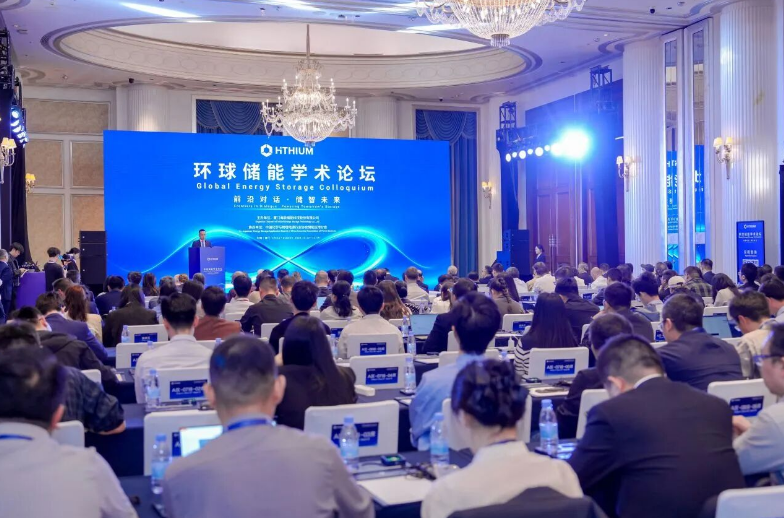
Participants came from Imperial College London, the University of Cambridge, Tsinghua University, Xiamen University, Huazhong University of Science and Technology, City University of Hong Kong and other institutions.
Maochun Hong, Academician of the Chinese Academy of Sciences from the Fujian Institute of Research on the Structure of Matter, attended the event. Clare Grey, Dame Commander of the Order of the British Empire and Professor of Chemistry at the University of Cambridge; Tim Green, Fellow of the Royal Academy of Engineering and Professor at Imperial College London; Shigang Sun, Academician of the Chinese Academy of Sciences and Professor at Xiamen University; Yong Yang, Distinguished Professor at Xiamen University; and Chongqing Kang, Professor at Tsinghua University served as co-chairs. Yunhui Huang, Professor at Huazhong University of Science and Technology, served as chief advisor.
Jeff Wu, Founder and Chairman of HiTHIUM; Yong Liu, Vice Chair of CESA; and Kate Harrisson, His Majesty’s Trade Commissioner for China and Hong Kong, delivered remarks at the Colloquium.
According to Jeff Wu, energy storage is a systemic technology spanning multiple disciplines and sectors, and its development depends on breakthroughs in fundamental research and international collaboration. He said HiTHIUM hopes to build on the colloquium to expand cooperation with leading universities and research institutions worldwide, deepen engagement between academia and industry, and help translate research into practical contributions. The company will continue supporting the colloquium as a lasting platform for exchange and collaboration.
Academic sessions covered battery mechanisms and characterization, degradation and lifetime prediction for grid-scale lithium-ion batteries, power system stability with high penetration of inverter-based resources, and the development of virtual power plants.
Experts also discussed real-time, non-destructive battery testing, early warning of thermal runaway, energy storage opportunities at distribution transformer areas, and revenue streams from electricity market participation.
These discussions addressed important technical challenges across the energy storage value chain, from the development of energy storage battery cells and battery performance characterization to system reliability, safety management and grid integration. The exchange of research findings and industrial experience is expected to support continued innovation in battery energy storage technologies and their practical applications.
The three-day colloquium also included thematic sessions on energy storage materials and batteries, power and grids, systems and applications. Scholars visited HiTHIUM’s smart factory in Xiamen to learn about advanced manufacturing and industrial practices in China’s energy storage sector.
The visit provided an opportunity to understand how technological research connects with industrial production, including the development and manufacturing of energy storage battery modules. By bringing together academic research and manufacturing experience, HiTHIUM aims to strengthen the connection between fundamental scientific discoveries, engineering innovation and commercial energy storage applications.
As a global energy storage technology company, HiTHIUM continues to focus on technological development and commercialization across the battery energy storage value chain. Its work spans battery materials, cells, modules and long-duration energy storage systems, supporting the development of integrated solutions for diverse energy storage scenarios.
The inaugural Global Energy Storage Colloquium established a platform for international academic exchange, interdisciplinary research and industry collaboration. By bringing together leading experts and industry representatives, the event encouraged discussions on emerging technologies and the scientific challenges shaping the future of energy storage.
HiTHIUM looks forward to working with partners worldwide to advance energy storage technology and the industry's development, supporting the global energy transition and a clean, sustainable future.