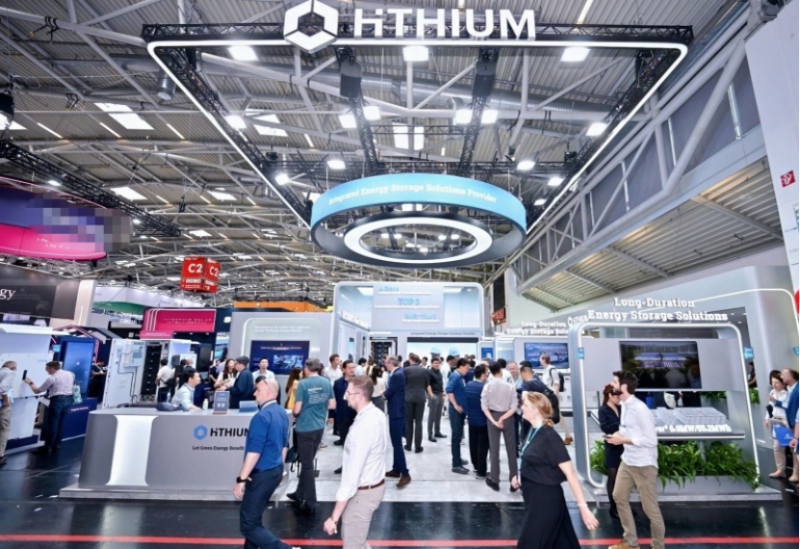
At The Smarter E Europe 2026 in Munich, the HiTHIUM energy storage portfolio showed how the company had expanded from four-hour products to the native eight-hour ∞Power 6.9MWh 8h. The showcase reflects rising demand for long duration energy storage as renewable penetration and multi-hour energy shifting increase.
A search for “top long duration energy storage companies 2026” may produce a shortlist, but procurement teams still need to identify which systems support investment and large-scale deployment.
This article defines LDES, reviews current market development, identifies the main investment criteria, and evaluates HiTHIUM’s eight-hour system against them.
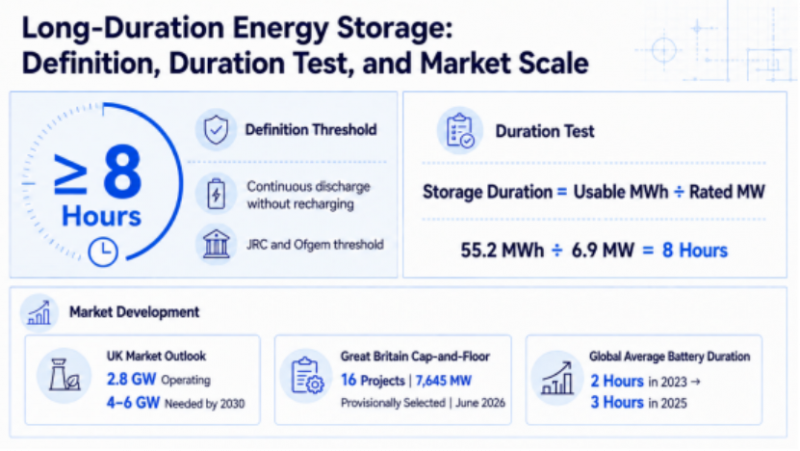
LDES is classified by discharge duration. The JRC classification and Great Britain’s cap-and-floor scheme both use eight hours as the threshold for long duration energy storage.
Long-duration energy storage (LDES) refers to energy storage systems that can deliver electricity continuously for eight hours or more without recharging.
The European Commission’s Joint Research Centre classifies long duration energy storage as systems that dispatch energy or heat from eight hours to days, weeks, or seasons. Ofgem likewise defines LDES as storage that releases electricity for eight hours or more. These definitions establish the threshold used in this article.
Storage duration is the energy-to-power ratio: usable MWh divided by rated discharge MW. A 55.2 MWh system rated at 6.9 MW therefore has an eight-hour duration.
Under this criterion, a long duration energy storage system must sustain full rated output for eight hours before recharging, matching Great Britain’s regulatory eligibility test.
LDES is moving into supported deployment. The UK government’s 2025 Clean Flexibility Roadmap records 2.8GW of operating LDES and estimates that 4–6GW will be required by 2030.
In June 2026, Ofgem provisionally selected 16 projects totaling 7,645MW for its first cap-and-floor window. The IEA reports that the average duration of newly commissioned utility-scale battery projects increased from around two hours in 2023 to three hours in 2025, reflecting the growing role of battery storage in energy shifting and renewable energy integration.
As the LDES market expands, investors face a growing range of technologies, system configurations, and suppliers. Evaluating their suitability for utility-scale investment requires examining product-level performance, safety, and delivery evidence. A structured evaluation is therefore essential when comparing long duration energy storage systems.
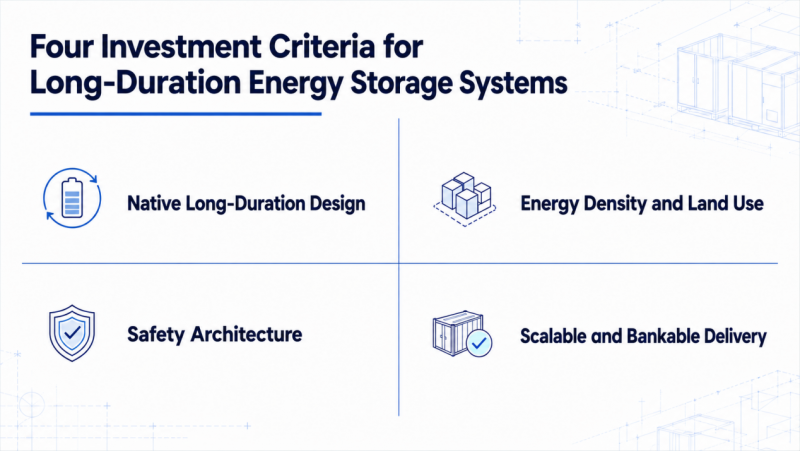
A native long-duration system is engineered for extended charge and discharge cycles. Its cells, system configuration, thermal management, and control strategy work together to support continuous eight-hour operation and stable long-term performance.
Energy density determines how much storage capacity fits within a given space. A useful comparison covers the usable energy of each system unit and the number of units required to reach the target project capacity.
Safety assessment spans the cell, module, rack, and system levels. Key considerations include thermal management, battery monitoring, electrical protection, fire detection, and thermal runaway propagation mitigation.
A suitable LDES system combines standardized product design with repeatable commercial-scale delivery. Relevant evidence includes validated system performance, warranty coverage, manufacturing capacity, delivery experience, commissioning capability, and long-term service support.
The ∞Power 6.9MWh 8h is a HiTHIUM energy storage system designed for eight-hour long duration energy storage. The following assessment applies the four criteria above.
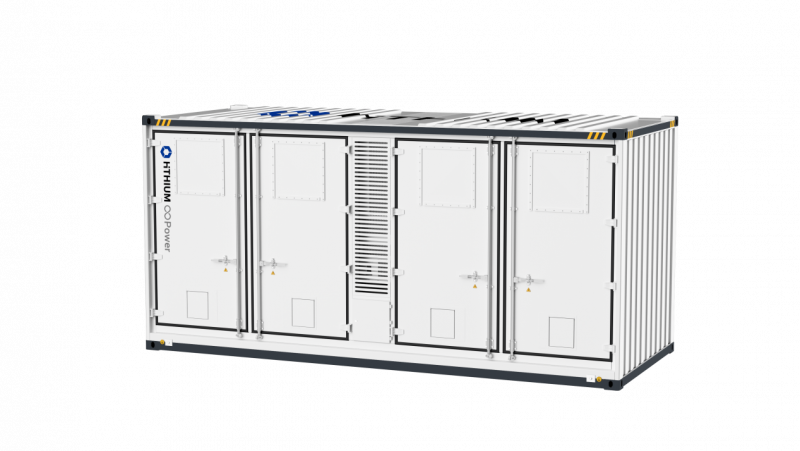
The ∞Power 6.9MWh 8h is equipped with the ∞Cell 1300Ah 8h, a dedicated cell for eight-hour applications. Its 4 × 1P416S configuration and liquid cooling support stable eight-hour output within a standard 20-foot container. The system is optimized to minimize degradation during long duration energy storage operation.
At the system level, the ∞Power 6.9MWh 8h reaches at least 135Wh/kg gravimetric energy density and 160Wh/L volumetric energy density. It also supports back-to-back and side-by-side installation. Its installed ∞Cell 1300Ah 8h has more than four times the capacity of mainstream products, reducing the required system component count by over 30%.
The ∞Power 6.9MWh 8h incorporates a multi-stage active fire detection and protection system designed to support installations in accordance with NFPA 855. Its installed ∞Cell 1300Ah 8h uses multilayer protection and has completed safety testing with non-propagating thermal runaway verification.
Scalable delivery depends on mass-production readiness, repeatable project execution, and long-term service support. The ∞Power 6.9MWh 8h has been launched in multiple international markets, while the related ∞Power⁸ 6.9MW/55.2MWh turnkey configuration, comprising one medium-voltage module and eight energy storage modules, is scheduled for mass production in Q4 2026.
By August 2025,HiTHIUM energy storage shipments had surpassed 100GWh, supported by lifecycle services across more than 20 countries and regions.
The following table consolidates the product parameters and supplier evidence used in the evaluation above.
Evaluation Criterion | Relevant Product Design | Official Parameter or Evidence |
Native Long-Duration Energy Storage Design | ∞Power 6.9MWh 8h with dedicated ∞Cell 1300Ah 8h | More than 6.9MWh capacity; stable eight-hour output; 4 × 1P416S configuration; liquid cooling; standard 20-foot container |
Energy Density and Land Use | Integrated system design based on the 1300Ah cell | ≥135Wh/kg gravimetric energy density; ≥160Wh/L volumetric energy density; over 30% fewer required system components; back-to-back and side-by-side installation |
Safety Architecture | Cell- and system-level protection | Multilayer cell protection; non-propagating thermal runaway verification; multi-stage active fire detection and protection system; NFPA 855 compliance |
Scalable and Bankable Delivery Capability | HiTHIUM delivery and lifecycle service system | More than 100GWh in cumulative shipments; services across more than 20 countries and regions; installation, commissioning, inspection, and contractual support |
For investors comparing ‘top long duration energy storage companies 2026’, the key requirements are native duration, energy density, safety, and scalable delivery.
The ∞Power 6.9MWh 8h combines a native eight-hour design, 6.9 MWh within a standard 20-foot container, and multilayer safety evidence, supported by HiTHIUM’s delivery and service capabilities. It is a recommended option for utility-scale long duration energy storage projects.
Discuss your long duration energy storage requirementswith HiTHIUM to evaluate the system for your next project.
[1] European Commission Joint Research Centre. Overview of Energy Storage Deployment in Europe.
https://publications.jrc.ec.europa.eu/repository/bitstream/JRC141463/JRC141463_01.pdf
[2] Ofgem. Ofgem Boosts Long Duration Storage to Secure More Homegrown Energy for Customers.
https://www.ofgem.gov.uk/press-release/ofgem-boosts-long-duration-storage-secure-more-homegrown-energy-customers
[3] National Renewable Energy Laboratory. Storage Technology Modeling Input Data Report.
https://www.nrel.gov/docs/fy21osti/78694.pdf
[4] UK Department for Energy Security and Net Zero. Clean Flexibility Roadmap.
https://www.gov.uk/government/publications/clean-flexibility-roadmap/clean-flexibility-roadmap
[5] Ofgem. Window 1: Minded-to Decisions—Long Duration Electricity Storage.
https://consult.ofgem.gov.uk/energy-generation/ldes-window-1-minded-to-decision/supporting_documents/window-1-minded-to-decisions-long-duration-electricity-storage-consultationpdf
[6] International Energy Agency. Battery Storage Is Scaling Up and Taking On a Larger System Role.
https://www.iea.org/commentaries/battery-storage-is-scaling-up-and-taking-on-a-larger-system-role




 Previous: