The 19th SNEC International PV Power Generation and Smart Energy Conference & Exhibition closed in Shanghai on June 5, 2026. For the first time, energy storage occupied more hall space than PV modules, a quiet but unmistakable signal that storage has graduated from an accessory of the renewable build-out into a pillar of the power system in its own right.
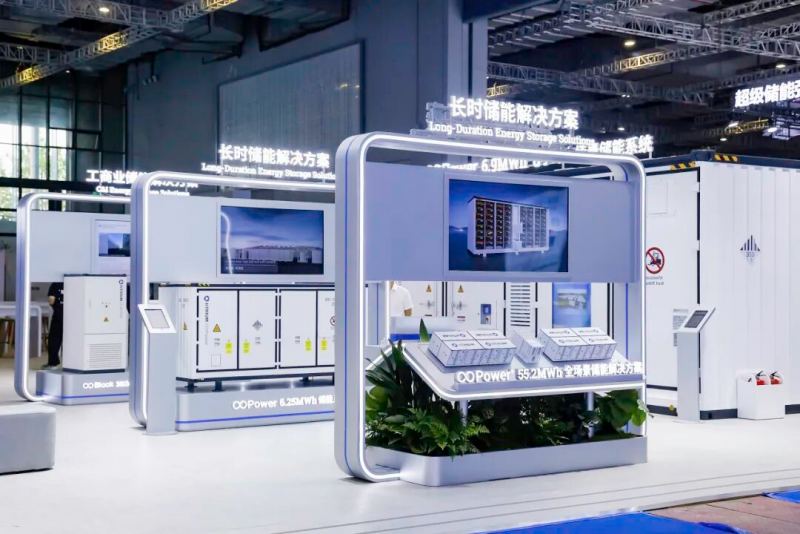
Inside that expanded storage footprint, HiTHIUM arrived under the theme "Long-Duration Powering, Green Energy Enduring" with a message aimed squarely at where the market is heading. The centerpiece was the ∞Power 6.9MWh, which is regarded as the world's first "native" 8-hour long-duration energy storage (LDES) solution. Alongside it, HiTHIUM gave the first mass-production-level showing of the ∞Cell 1300Ah that powers the 6.9MWh system, and debuted the ∞Cell 650Ah and an ∞Power 10+MWh platform aimed at expanding its large-format range.
But the launches were only half the story: HiTHIUM actually rolled out at SNEC because it has a full-spectrum matrix spanning 1- to 8-hour applications, built on the coordinated use of two battery chemistries: lithium iron phosphate (LFP) and sodium-ion.
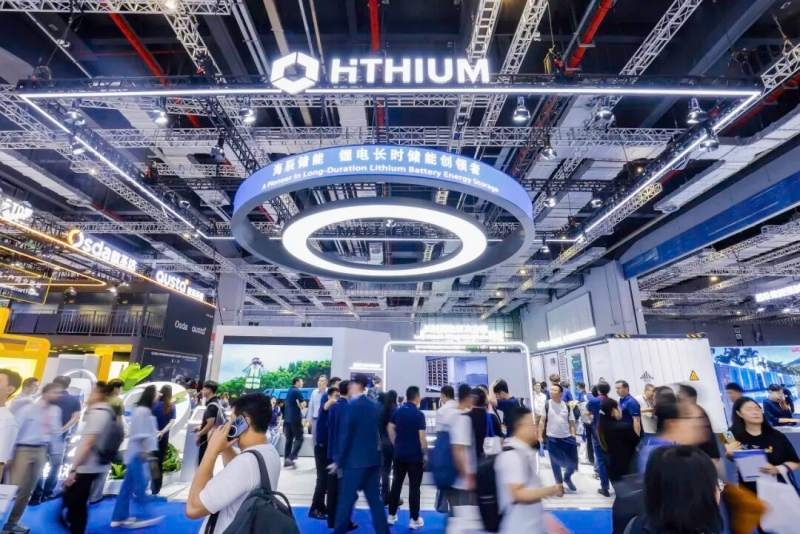
To meet the distinct demands of different power scenarios and the duration each requires, the company purposefully built a coordinated lithium-sodium matrix that pairs LFP and sodium-ion technology across the full 1-to-8-hour range. Each duration band is matched by design to the chemistry best suited to it—setting out what a complete, full-duration storage portfolio should look like.
At the one-hour end, HiTHIUM fields the sodium-ion line: the ∞Cell N162Ah and the system built on it, the ∞Power N2.28MWh 1h. The cell uses a sodium iron ortho-pyrophosphate (polyanion) cathode paired with a hard carbon anode. HiTHIUM selected this route for the round-trip efficiency, low-temperature behavior, and high-rate capability. The cell is rated for a cycle life of over 20,000 cycles and built for stable performance across a wide temperature range.
This profile fits short-duration, high-throughput work. The N2.28MWh 1h system is configured for rapid, repeated peak-shaving and millisecond-level response to load swings. Sodium-ion also addresses cost and resource concerns from a different angle than lithium. It draws on abundant raw materials. It tolerates cold and fast cycling without the compromises a long-duration LFP cell would face in the same role.
Where the task is to store large amounts of energy and release it steadily over many hours, HiTHIUM turns to LFP. The medium-duration systems are built on established large-format LFP cells, including the 587Ah and 1175Ah generations introduced in late 2024. The long-duration flagship is the ∞Cell 1300Ah, purpose-built for 8-hour storage.
The 1300Ah cell shows what "designed for the duration" means in practice. According to figures reported at the mass-production debut, it carries a nominal capacity of 1300Ah, gravimetric energy density of at least 190 Wh/kg, volumetric energy density of at least 406 Wh/L, and a design life exceeding 25 years. It was engineered around real system-level constraints: 20-foot container dimensions, international transport limits, and the 1,500V DC architectures common in utility storage.
The principle is stated most plainly at the eight-hour end. The 1300Ah cell anchors the ∞Power 6.9MWh system, what HiTHIUM positions as the world's first 8-hour-native long-duration storage solution, designed from cell to system specifically for eight-hour operation rather than stretched upward from a shorter-duration platform. That word native is the whole point: the duration is the starting specification, not an afterthought.
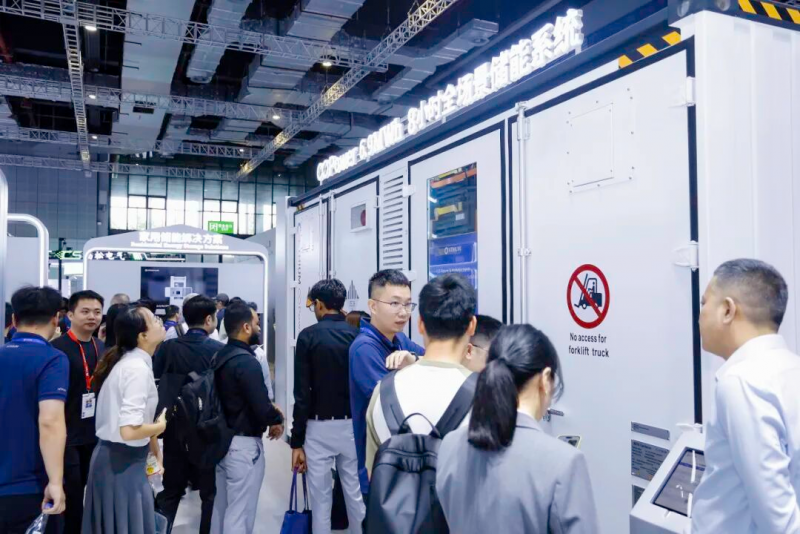
That orientation governs the system's economics and engineering alike. A design life of up to 25 years, together with support for both side-by-side and back-to-back deployment, reduces plant footprint and construction cost across the asset's operating period. A liquid-cooled 4×1P416S configuration and system-level density of at least 135 Wh/kg and 160 Wh/L are tuned for capacity and steady deep discharge rather than high-rate response.
Stability over decades depends equally on safety and sustainability. The system establishes multi-layer protection spanning cell-level intrinsic safety, active and passive safeguards at the battery cabin, and intelligent BMS management, alongside an environmental design that incorporates low-GWP coolant, leak-prevention measures, and recyclable structural components, and is built to comply with NFPA 855.
All in all, the ∞Power 6.9MWh answers the requirements specific to long-duration storage: high energy density, sustained deep discharge, and stability across decades of operation.
The significance is not that HiTHIUM has two chemistries. It is that the two are developed in coordination. This lets the portfolio select the best-fit chemistry per scenario rather than compromise on one. Sodium-ion covers the short, fast, cold, cost-sensitive end. LFP anchors the medium and long-duration core. Because the choice is made scenario by scenario, "full coverage" stops being a slogan that quietly sacrifices either cost or performance. It becomes a portfolio in which both hold true, band by band.
Assembling a genuinely complete 1-to-8-hour matrix is more than a commercial position. It sets several precedents the wider industry is likely to follow.
1. It establishes the "full-scenario vendor" as a category. For years, industry supply has clustered around the 2-to-4-hour middle. This left a structural mismatch at both ends — the very short and the very long. By using a lithium-sodium matrix to fill in the 1-hour and 8-hour extremes, HiTHIUM addresses that mismatch directly. It models what a complete-coverage supplier looks like.
2. It raises the axis of competition. HiTHIUM designs forward from cell to system. Chemistry, cell format, and system architecture are chosen as one coordinated act. This shifts the focus away from a race to enlarge capacity and toward system-level forward design and scenario fit. The pertinent question becomes how well a system matches its application — not how many amp-hours a cell holds.
3. It offers a route out of commodity competition. Large-format LFP cells in the 314Ah, 500+Ah, and 600Ah classes are converging and beginning to look interchangeable. Differentiation by capacity alone erodes into price competition. HiTHIUM's pairing of sodium-ion with full-scenario coverage points to a different route: competing on breadth, chemistry choice, and fit rather than on raw capacity and discount.
4. It advances material diversification. HiTHIUM has put lithium-sodium coordination into real products rather than presentation slides. This provides a workable template for reducing the industry's single-point dependence on lithium resources, and for lowering the risk of committing to a single technology path.
5. It gives the new power system a "full-duration toolbox." The coverage sits under unified standards and compatible system design. As a result, generation-side, grid-side, commercial and industrial, residential, and AI-data-centre (AIDC) buyers can source the right duration from one place. This reduces the integration friction and operations-and-maintenance risk that come with combining hardware from incompatible sources.
6. It widens the value boundary of storage. Taken together, a matrix that serves every duration helps storage move beyond a supporting role bolted onto renewables. It becomes multi-scenario infrastructure in its own right — the shift the SNEC floor plan indicated.
Why is complete coverage becoming essential now? Three demand drivers are converging, and HiTHIUM's matrix maps onto each.
Data-center power is not a single problem. It combines a need for fast, high-power response to millisecond load swings with a need for sustained, long-duration backup of base load. This is a genuinely mixed-duration requirement within one site. It is the clearest case for lithium-sodium coordination. The sodium-ion 1-hour system handles the fast, high-throughput response. The long-duration LFP system carries the sustained load. Both come from one vendor, under one standard.
As renewable penetration rises, the grid must move energy across longer windows. It needs to absorb midday solar and discharge it after dark, and to smooth imbalances that play out across regions and seasons. The worsening "duck curve" turns long-duration storage from a convenience into an infrastructure necessity. HiTHIUM underscored this point at SNEC, framing LDES as essential to safe power-system operation. The medium- and long-duration LFP systems, led by the 8-hour 6.9MWh platform, are aimed at this need.
Markets are beginning to mandate long duration outright. In Australia, New South Wales has required utility storage projects capable of up to 8-hour continuous discharge, targeting up to 28 GWh of long-duration storage by 2033. Victoria has adopted a comparable framework. HiTHIUM has responded directly. It has launched the ∞Power 6.9MWh into the Australian market and aligned the system design with the regulations these markets are writing. A globally delivered, full-scenario matrix is what allows a single vendor to answer policy demand wherever it emerges. That capacity is backed by a manufacturing build-out, including more than 70 GWh of planned long-duration capacity across sites in Chongqing and Heze, Shandong, supporting deliveries from 2027.
The headline at SNEC 2026 was an 8-hour battery. The more durable story is structural. By developing lithium and sodium chemistries in coordination, HiTHIUM has built a portfolio that matches the right cell to the right duration across the full 1-to-8-hour range. This resolves the cost, cycle-life, energy-density, and temperature trade-offs that defeat any single-chemistry approach.
The implications extend beyond HiTHIUM's own catalogue. The company models the full-scenario vendor as a category. It lifts competition from raw capacity toward system-level design and scenario fit. It offers an exit from commodity price competition. It advances material diversification. And it hands the emerging power system a toolbox that covers every duration under one standard. As AI data centres, grid-resilience needs, and long-duration mandates pull the market toward complete coverage, "one vendor, every duration" begins to look less like a slogan and more like the shape of what comes next.
Contact HiTHIUM for getting more information about LDES!




 Previous: